Machines Scale. Attention Doesn't.
Dozens of agent sessions in parallel, each with a few small questions — by mid-afternoon the person answering has nothing left for the one that matters. Five levels we use, from a single line of prompt to a decision inbox, so that person decides less, decides faster, and no answer gets lost.

The Bottleneck Moves
With a single chat window, the AI asks and you answer. Nobody gets tired.
With a few agent sessions running in parallel, it is still manageable. Each session stops now and then to ask something: which option, is it fine to delete this, has the design been approved yet. Every question is small — one glance, and it is answered.
But the scale does not stop at a few. Once it reaches dozens of sessions, those small questions spread across the whole day, in dozens of different windows. On our team, some people run hundreds of sessions in a day. By mid-afternoon the person answering has nothing left for the one question that actually matters.
That is decision fatigue. It does not come from one hard decision. It comes from a great many easy ones, arriving at the wrong time, in the wrong place.
For us, this is the real bottleneck of the whole way of working with many agents. Machines can be multiplied. The attention of the person giving them work cannot. If that person is spent before lunch, adding agents only makes the queue longer.
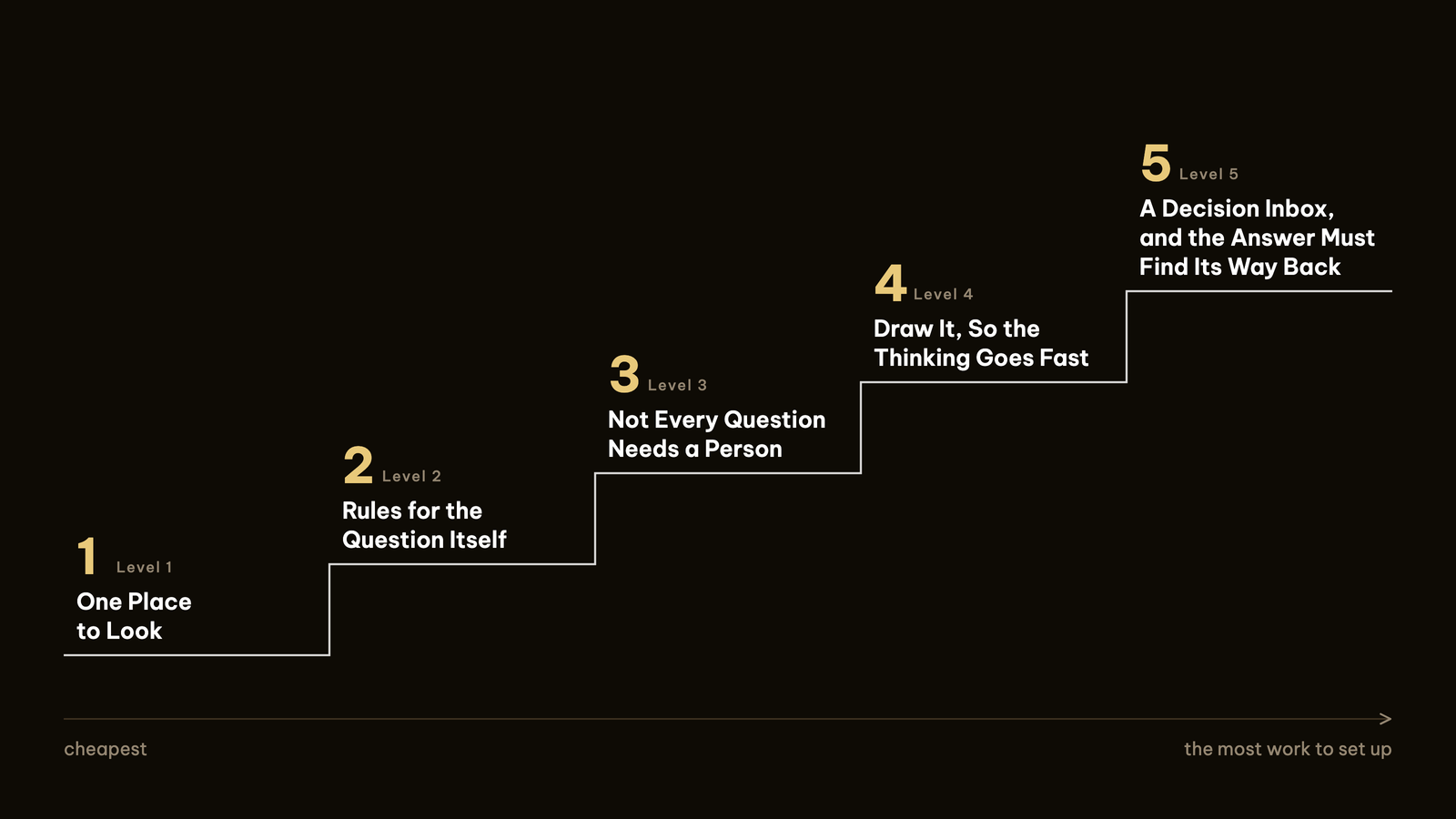
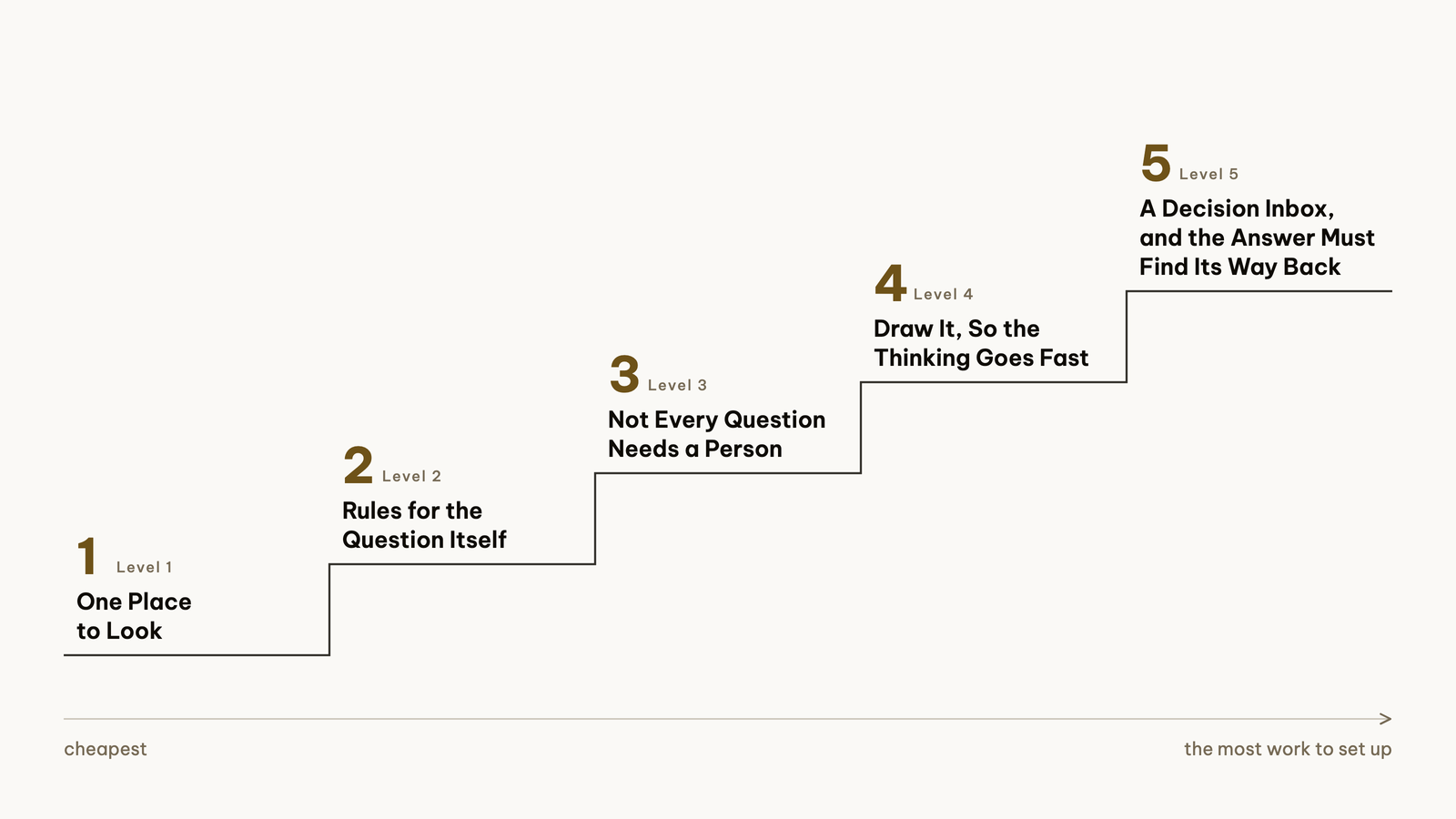
Below are the five levels we use, from the cheapest to the most work to set up. Each one stands on its own; how far you climb depends on your scale.
Level 1 — One Place to Look
The simplest fix needs no tooling at all: tell every session to report to one session, then watch only that one.
It takes a single line in the brief: "When you finish, or when you need to ask something, report to the session named …". If you already have a layer that controls sessions (we use Muster), it becomes "report to this link".
The gain is not fewer questions. It is fewer places to look. Dozens of windows become one. The low hum of worry — "is some session sitting there waiting for me?" — goes away.
Level 2 — Rules for the Question Itself
Most of the fatigue does not come from deciding. It comes from rebuilding the context before you can decide. A question like "how do you want this done?" forces you to open the session, read from the top, and invent the options yourself.
So we put rules on the question. Every question an agent sends up must:
- Stand on its own — readable in about 30 seconds, no need to open the session.
- Come with options — A, B, C, D, one click.
- Carry the agent's own recommendation, with the reason. This is the one that matters most: in most cases the answer is simply "go with the recommendation".
- State the consequences and the way back for each option.
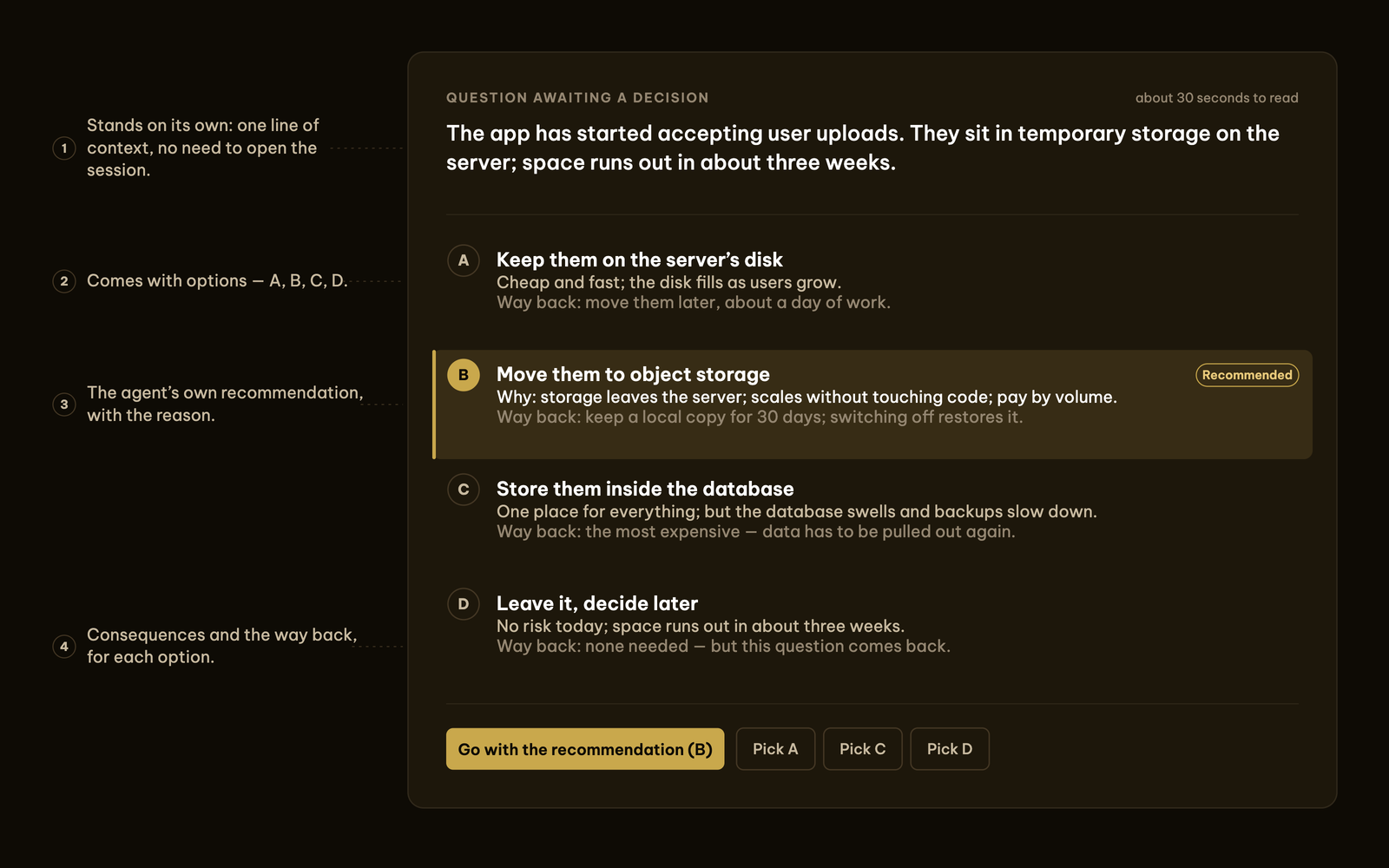
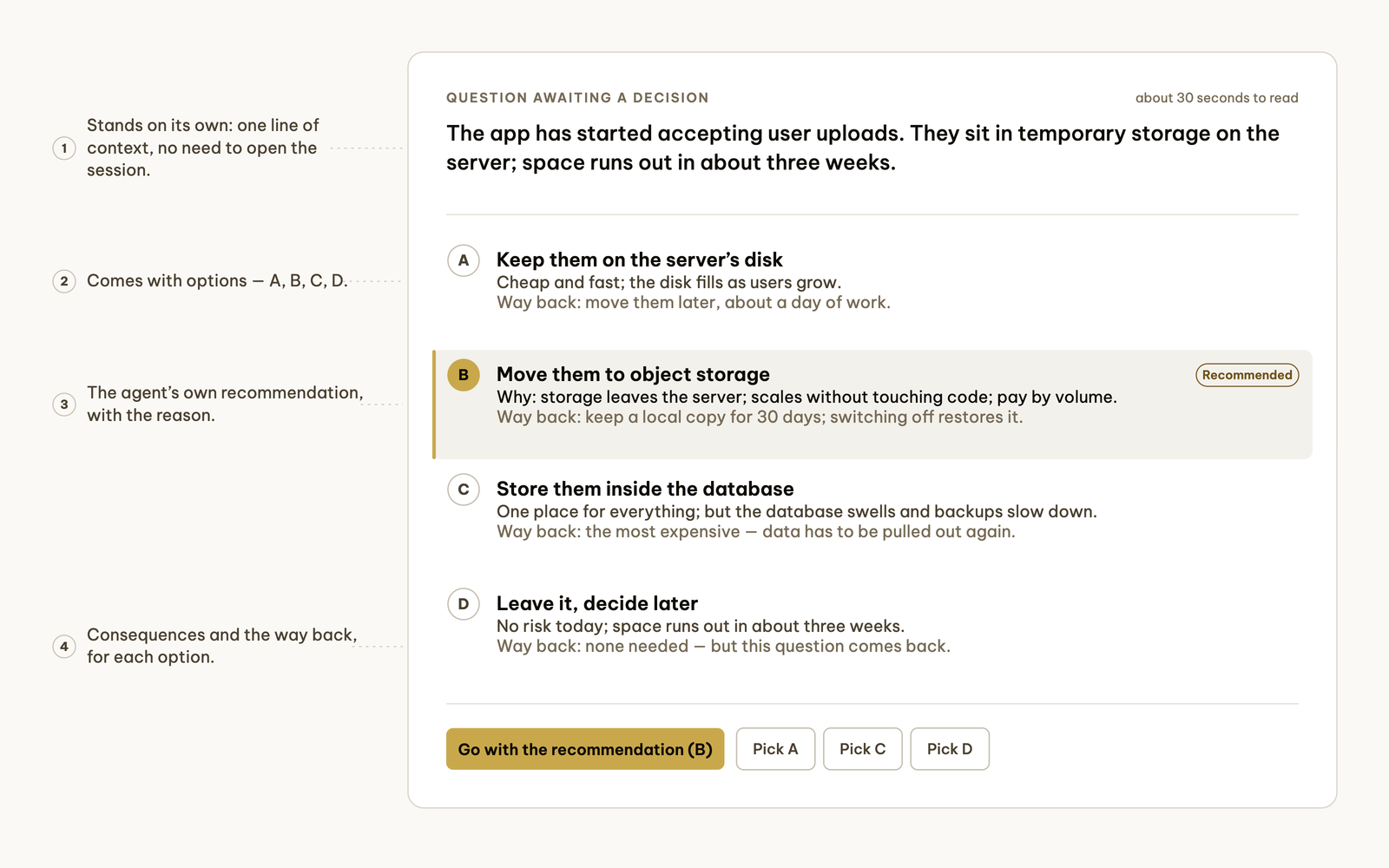
The agent is not allowed to push the thinking upward. It thinks, then proposes; the person approves or redirects.
Level 3 — Not Every Question Needs a Person
This is the level that removes the most fatigue, and the one most often skipped.
When we counted our own "waiting for the owner" queue, the result was a surprise: out of 20 items, only about 5 were real decisions. The rest were small tasks blocked on a nod, things to close out, things to tidy up. The person answering had to wade through 15 items that meant nothing to find the 5 that did.
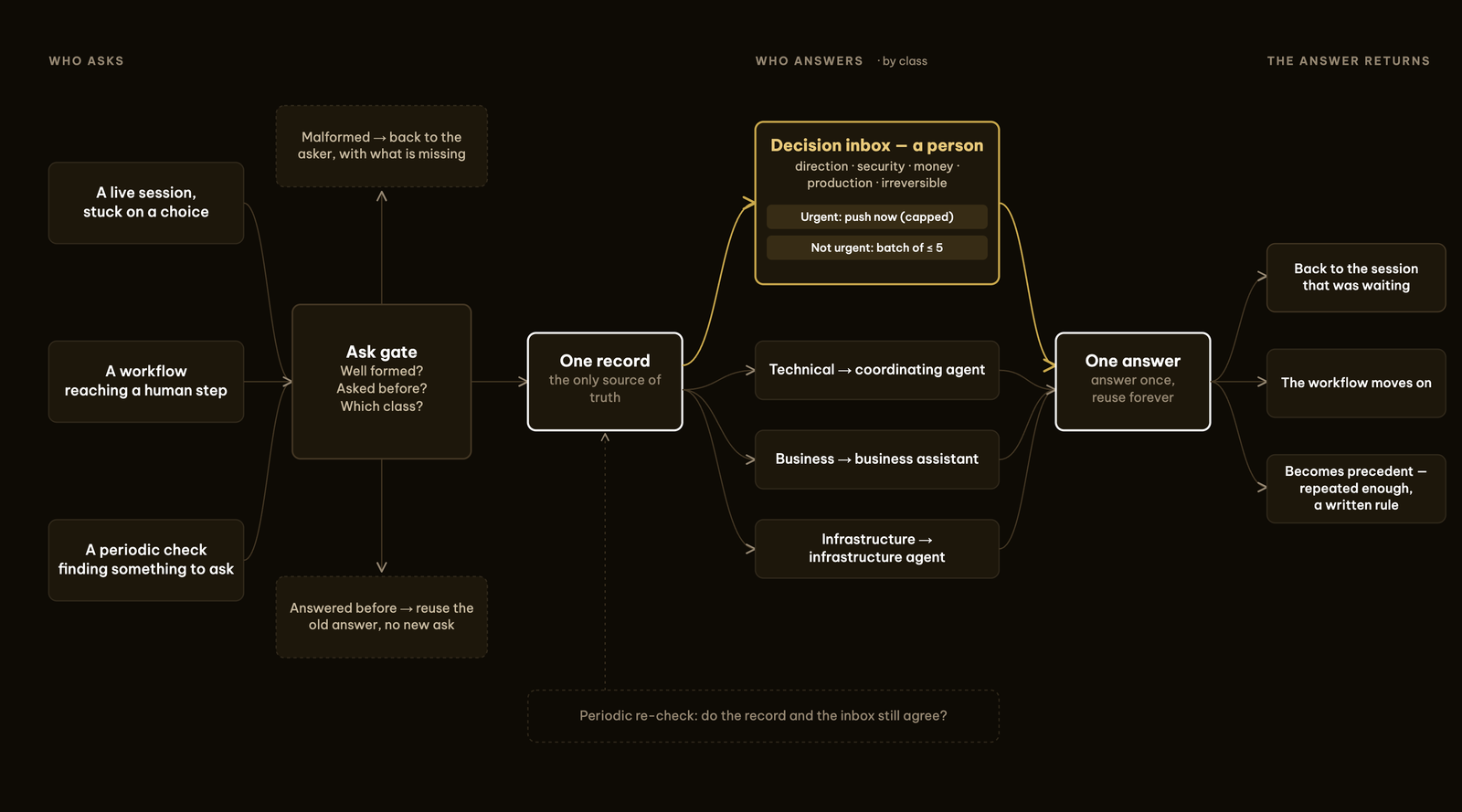
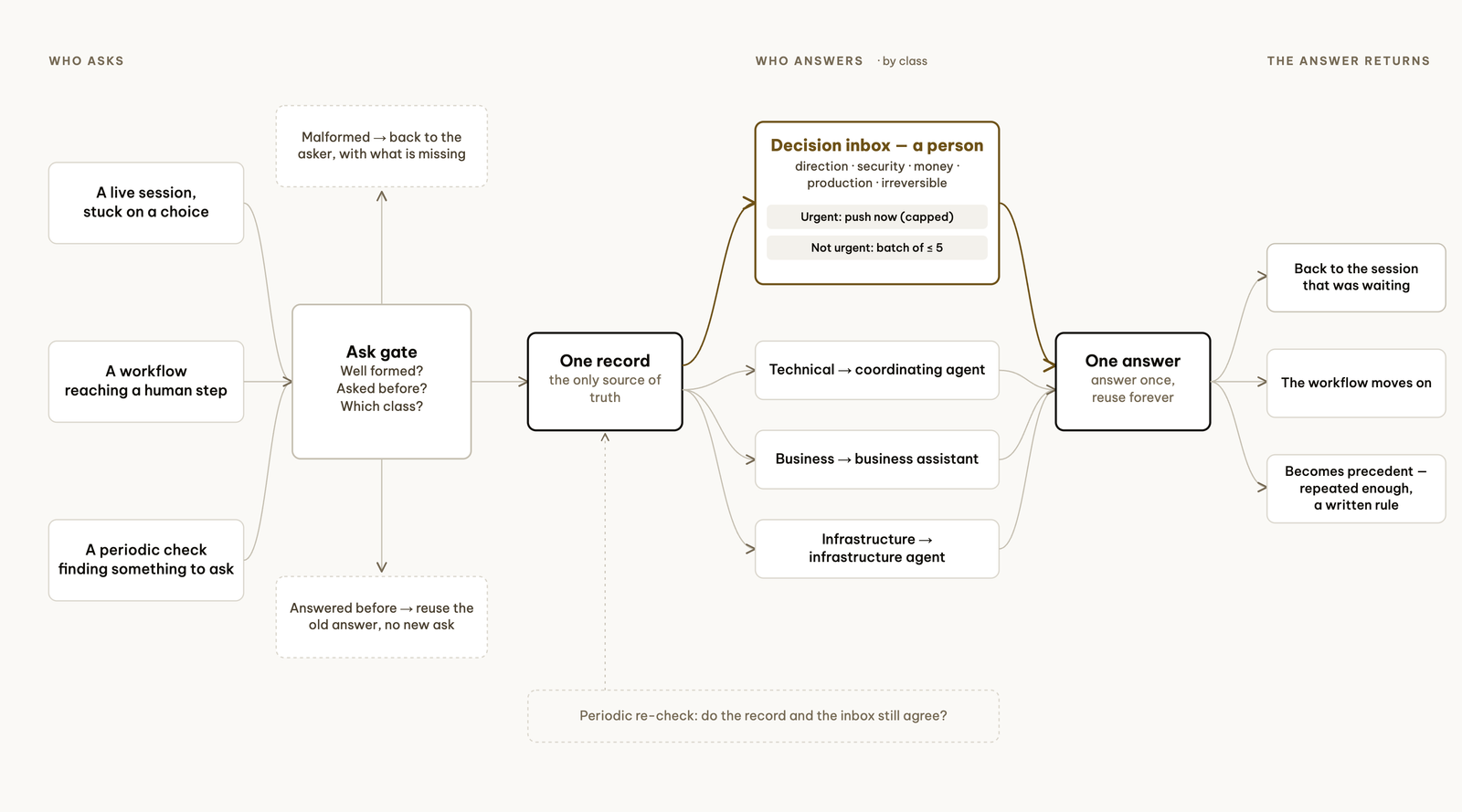
The fix is to classify the question at the moment it is asked, and route each class to the right place:
- Technical questions → the coordinating agent answers.
- Everyday business questions → the business assistant answers.
- Only a narrow set reaches the owner: direction, security, money, production, and anything that cannot be undone.
Alongside it, a second sorting question: is this reversible? If it can be redone, the agent does it and reports back in one line. Only one-way actions need asking first.
And delegate in advance, by scope. For example: "In this project, when every test is green, you may merge into the main branch yourself." One delegation removes hundreds of questions down the line.
Decision fatigue, much of the time, is really sorting fatigue — and sorting is something a system does better than a person.
Level 4 — Draw It, So the Thinking Goes Fast
Some problems stay heavy no matter how tightly the question is written, because the reader still has to build the picture in their head: a data flow through three systems, five parties involved, two architectures trading off against each other.
For these, we have the agent — working with an agent that specialises in design — draw the whole thing as a diagram before asking. Seen whole, once, the decision usually arrives in minutes rather than sessions.
It costs more tokens. But set against the cost of a wrong architecture decision, or an afternoon blocked because the decider could not yet picture the problem, it is cheap. If the design agent already has drawing tools that follow your visual identity, it is cheaper still.
Level 5 — A Decision Inbox, and the Answer Must Find Its Way Back
The last level is infrastructure: one decision inbox for every question that needs a person, from every session, on every machine. Once answered, the answer returns on its own to the session that was waiting, and the work continues.
The hard part is the second half. We have lost two approvals this way: the approve button wrote to one place, the process read from another, and the inbox showed empty. An answer that cannot get back to where the work is happening is the same as no answer.
A few hard rules:
- One record per question and its answer.
- Two speeds: an agent that is blocked gets a push notification right away (with a cap); non-urgent items are batched, no more than 5 per batch.
- Silence is never consent.
- Answer once, reuse forever. A question asked twice is a system fault; a question that keeps coming back becomes a written rule.
Measure It, or You Will Not Know
"It feels less tiring" is hard to trust. We track a few numbers:
- Questions reaching the owner per day — this one has to fall when you climb to Level 3.
- Time from question to answer.
- Share of questions settled by precedent instead of being asked again.
- Share of agent recommendations the owner rejects. When this is high, the agents are misreading intent — fix the rules, not the phrasing of the questions.
The Most Expensive Thing
Every level above comes down to one point: in an organisation with many agents, the expensive thing is not the machine — it is the attention of the person who knows how to give it work. Protecting that attention is a design job, not a matter of personal discipline.
Level 1 costs one line in a prompt. Try it today.